
3 Psychological Reasons Your Habits Keep Failing
A psychologist explains the hidden pitfalls that keep habits from becoming permanent routines.

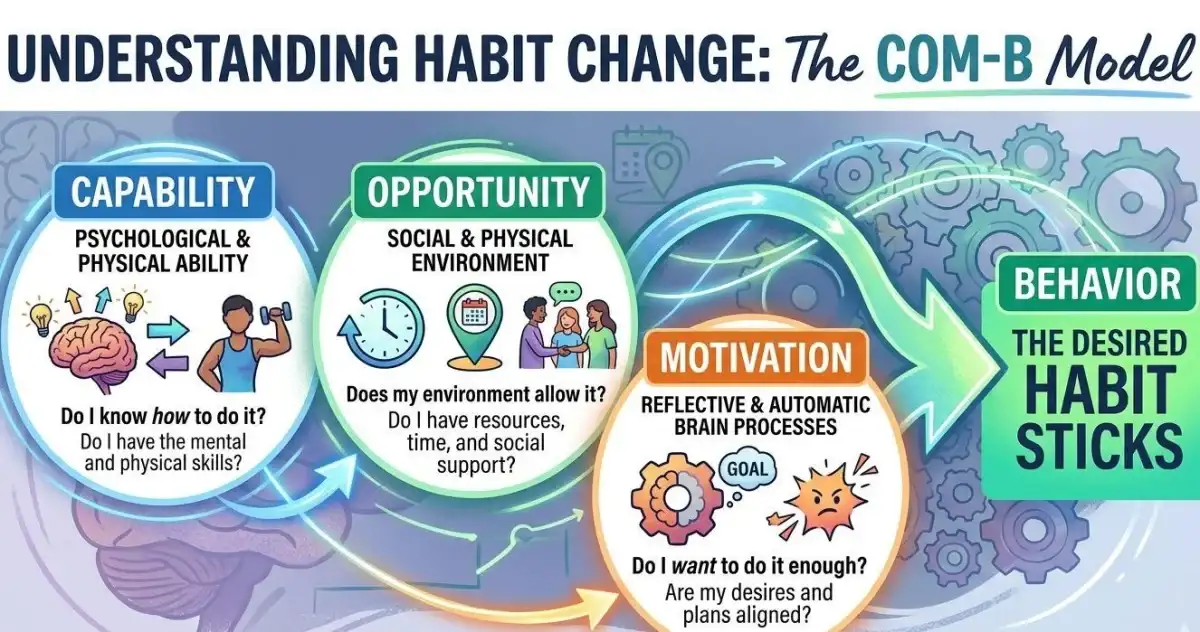
Most of us have, at some point in life, tried to start a new habit, only for our initial enthusiasm to fade. In time, we end up right back where we started. While popular self-help advice focuses on willpower and motivation, decades of behavioral science suggest that this is only part of the reason why it can be so hard to make good habits stick. To understand this near-universal experience, psychologists increasingly use a simple yet powerful framework called the COM-B model.
Developed by Susan Michie, Maartje van Stralen and Robert West in a 2011 study from Implementation Science, COM-B stands for Capability, Opportunity and Motivation, which translate to Behavior.
Rather than assuming behavior naturally follows desire, COM-B treats habit change as a diagnostic problem: if a behavior isn't happening, it's likely that one (or more) of these components is either missing or misaligned. Here are three core reasons why your habits might not be sticking, as well as some practical ways to diagnose and fix them, according to the COM-B model.
1. Skill And Knowledge Gaps Make Habits Harder To Stick
Most advice you'll read on habit formation will assume that you can already perform the behavior you want, and that you just lack the discipline. However, research shows that, often, this isn't true. It's usually the case that you simply haven't built the skills or psychological resources needed for the behavior to become habitual.
In COM-B, capability has two dimensions:
- Physical capability. Can you physically do the task?
- Psychological capability. Do you know how to do it and manage the cognitive elements of the behavior, like planning, self-regulation or remembering?
Say, for instance, that you want to start running daily. You might have every intention to run every day, but if you've never structured warm-ups, pacing plans or recovery, then your psychological capability is weak. Likewise, if you have underlying injuries or fatigue, then your physical capability limits you.
A 2021 empirical study published in BMC Public Health directly tested the COM-B model in the context of physical activity and eating behaviors in young adults. The researchers found that capability was strongly linked to whether the behavior actually happened, while also influencing behavior indirectly through motivation as well.
In other words, the more capable a person felt in their ability to do the behavior, the more motivated they became to act, and the more likely the habit stuck. This is because when you know what to do and feel confident that you can do it, your brain won't have to debate the choice to do it. Capability reduces friction.
If you find yourself procrastinating because a habit feels harder than anticipated, it's likely because you haven't built the underlying capability necessary for it to feel easy. You're asking yourself to be a person you haven't learned to be yet.
So, instead of jumping the gun and setting an unrealistic goal — like, "I want to meditate daily" when you've never meditated before, or "I want to run five miles a day" when you've never run more than two — start by trying to break it into capability-building steps:
- Learn the basics of the habit first (e.g., the foundations of meditation, good practices for running beginners, etc.)
- Practice these basics in small increments (e.g., start meditating for a minute at a time before increasing, start by running a mile a day and work your way up to five
Once you can do the basics consistently, making it a habit will be significantly easier than starting from nothing.
2. Your Environment Can Sabotage Your Habits
Willpower is viewed as the most instrumental part of habit formation in self-help circles, but your environment exerts just as powerful an influence on whether a habit sticks — if not more. And often, it exerts this influence outside of your conscious awareness.
In COM-B, your environment falls part of "Opportunity," which refers to all the external factors that make a behavior possible or block it:
- Physical opportunity. Access to, time dedicated to or cues for the habit.
- Social opportunity. Cultural norms or support from others that make the habit feel natural.
In the BMC Public Health study discussed earlier, the researchers found that people who had physical and social opportunities supportive of their goals were more likely to form new behaviors. Notably, this effect worked through motivation: when an individual's environment supported a behavior, they were more motivated to do it.
Research on habit change notes that habits live where context and action form strong associations. This means that a repeated behavior will become automatic if there are cues in your environment that can reliably trigger it. But when these context cues are unstable, inconsistent or mismatched with your habit goal, that automaticity will never develop.
For instance, imagine:
- Trying to make a daily habit of studying without having a dedicated workspace
- Planning to walk more without having safe paths nearby
- Aiming to eat healthy when your house is stocked only with junk food
In each of these cases, the environment isn't prompting the desired behavior. You have no cues to rely on, so you must rely only on willpower instead. Naturally, this will make the desired habit far more difficult to embed within routine.
This is why it's recommended that you design your environment to support your behavior if you want to create lasting habits. Important steps in this process include:
- Set clear cues (e.g., place your running shoes by the door)
- Remove friction (e.g., prepare meals in advance)
- Enlist social support (e.g., ask a friend to join your habit)
- Change context (e.g., study in specific locations only)
Remember, your willpower will always feel like a weak lever if your environment keeps activating old behaviors.
3. Your Motivation Is Misaligned With Your Habits
Motivation gets a lot of attention in media surrounding success and productivity. In COM-B, however, individuals are encouraged to stop viewing motivation as simply "wanting something." Instead, it's suggested that motivation has two key forms:
- Reflective motivation. Conscious goals, plans, intentions.
- Automatic motivation. Habits, emotional reactions, impulses.
If your motivation is only reflective — "I want this, and I think it's good for me" — then you're essentially expecting that your conscious self-control will always override automatic tendencies. But in the long run, this is as losing battle because attitudes and intentions will rarely lead to sustained behavior change without automatic support.
This is because habits involve automaticity: the ability to respond without deliberation. And this is precisely where many people fail.
This mirrors other 2018 research that found that intrinsic rewards accelerate habit formation. In other words, behaviors that are experienced as pleasurable or meaningful will become habitual faster than those that aren't. Perceived rewards will strengthen these habit pathways, especially when the behavior is consistently performed in the same context.
From this perspective, there are two common motivation errors that make habits harder to stick:
- You're motivated only by abstract goals (e.g., "be healthier"), not by ingrained motivation tied to rewards or identity (e.g., "being healthier will make me more energetic, happier and satisfied in life").
- Your automatic drivers are aligned with old habits, making it harder for new ones to compete.
The latter error can be especially damaging. For instance, you may want to wake up early every day, but if your automatic reward system is wired to relax in bed every morning, then your reflective motivation must fight against automatic impulses. In this sense, true habit formation involves shaping automatic motivation:
- Connect your habit to meaningful rewards (e.g., celebrate small wins)
- Link the behavior to your identity (e.g., say, "I am a runner," instead of, "I want to run more")
- Make the habit intrinsically enjoyable (e.g., listen to music during exercise)
Not only will strategies like these motivate you more, but they'll also wire your brain to treat the new behavior as default over time.
Do you thrive on hard mode or find flow in simplicity? Take this fun test to uncover how you make good habits stick: Friction Maxxer Energy Test
About the Author
Mark Travers, Ph.D., is the founder of Therapytips.org, where he helps match new clients with the right therapist on the team — request a session or get matched here. Mark received his B.A. in psychology, magna cum laude, from Cornell University and his M.A. and Ph.D. from the University of Colorado Boulder. His academic research has been published in leading psychology journals and featured in major outlets including The New York Times and The New Yorker. He is a regular contributor for Forbes, CNBC, and Psychology Today.
More Articles For You
-
Psychologist: This Is The Fastest Way Out Of A Negative Thought Spiral
You can never think your way out of a thought trap, the solution lies somewhere else.
-
Psychologist: 1 Habit All Intelligent People Swear By
Most of us dump this habit the moment we’re out of school. The ones who stick with it benefit exponentially.