
Do You Guard Your Heart or Wear It Openly? Discover Your Emotional Armor
We all develop ways to guard our most vulnerable parts. Discover the pattern your mind relies on.

Everyone protects their heart in some way or another. Some build tall, sturdy walls that are almost impossible to get past; some put up careful gates that they open only for a select, trusted few; others wear their heart openly and deal with the fallout later. These strategies are commonly known as "emotional armor." The term aptly describes the largely unconscious regulatory and self-protective strategies that govern:
- How much of our inner world we expose,
- To whom we expose it,
- And under what conditions we expose it
These strategies are adaptations that we develop in response to the emotional environments we grew up in and the relational experiences that shaped us. However, many will find that the armor that once served a purpose can, over time, become a liability.
Understanding your own protective style is the first step toward choosing it more deliberately. To this end, I developed the Emotional Armor Test, which identifies which of eight evidence-informed archetypes best describes how you guard your inner world.
But first, it's crucial to grasp the science behind what the test actually measures. Here's how the following three constructs inform individuals' emotional self-protection strategies.
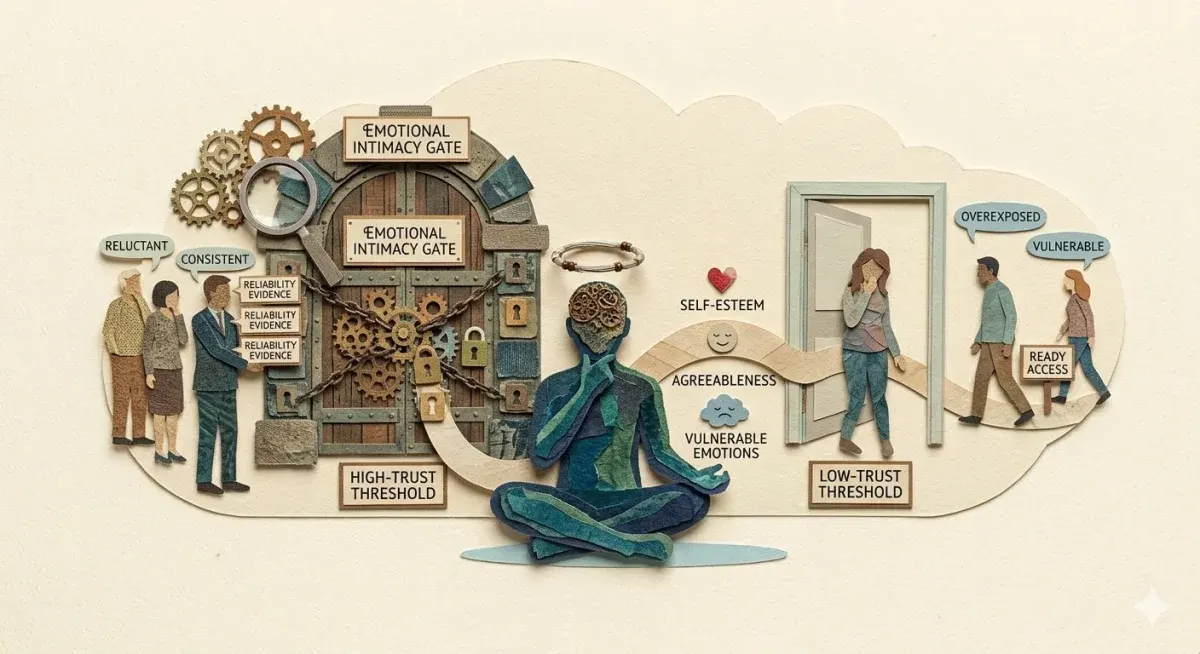
1. Emotional Trust Threshold
The first dimension concerns what researchers refer to as the gating mechanism of emotional intimacy: the internal threshold a person requires before granting another person meaningful access to their inner life. Namely, there are:
- High-trust-threshold individuals, who are reluctant to open up unless they've accumulated substantial evidence of a partner's reliability, consistency and goodwill
- Low-trust-threshold individuals, who extend access more readily, sometimes before having that same evidence
In a 2017 study published in the Journal of Personality and Social Psychology, psychological researchers traced this pattern across six studies using correlational, partner-report and experimental methods.
The authors found that trust mediates the relationship between self-esteem, agreeableness and emotional self-disclosure. More importantly, this effect was especially pronounced for disclosures of vulnerable emotions like sadness, as well as in high-risk relational contexts.
In simple terms, this means that how trusting you are isn't just a reflection of your personality, nor is it solely a reflection of your past relational experiences. Instead, it's the inverse: trust is the functional mechanism that opens the door to everything else.
This means that a person with a chronically high trust threshold may appear cold or withholding to partners who interpret caution as disinterest. Contrastingly, someone with a very low threshold may find themselves overexposed in relationships that can't bear the weight of that disclosure just yet.
Neither extreme is inherently problematic, but both carry characteristic risks. Thankfully, those risks become clearer once you can name them.
2. Emotional Suppression
The second dimension measures the degree to which a person prevents themselves from expressing their emotions outwardly. Importantly, this reflects deliberate attempts to detach inner experiences from their outward signal. It's not the same as the absence of emotion, nor not feeling anything at all.
This is what emotion regulation researchers call "expressive suppression," and it is among the most studied constructs in the field. In landmark 2003 research published in the Journal of Personality and Social Psychology, across five studies, researchers demonstrated that individuals who habitually suppress emotional expression experience suffer more than others.
More specifically, they were found to display less positive emotion, experience more negative emotion internally and show measurably worse interpersonal outcomes compared to individuals who regulate emotion primarily through cognitive reappraisal. Some of the costs of this suppression included lower social support, less closeness to others and reduced relationship satisfaction.
The mechanism is worth understanding clearly. What few realize in the moment is that suppression does not — and cannot — eliminate emotions altogether. All it does is temporarily interrupt its outward transmission, while still leaving the internal experience largely intact.
In this sense, a person who works overtime to appear "nonchalant" or "unfazed" by events is effectively spending their life managing the gap between what they experience and what they show. In time, that labor accumulates, and the signal that others use to calibrate closeness never arrives.
3. Emotional Avoidance
The third dimension concerns how individuals manage their emotions internally. More specifically, it assesses whether they tend to:
- Move toward difficult emotional states, experiencing them fully without rushing to resolve them, or
- Move away from difficult emotional states, usually by redirecting attention into activity, productivity or busyness
This is the construct clinical psychologists call "experiential avoidance," and it sits at the theoretical core of Acceptance and Commitment Therapy for a reason: research consistently finds it to be one of the more consequential emotional regulation strategies that a person can employ.
According to a 2017 study published in the Journal of Psychopathology and Behavioral Assessment, distraction (the behavioral strategy of keeping busy when emotions press) is not inherently adaptive or maladaptive. In reality, its effect will depend entirely on what it is paired with.
For instance, participants in the study who used distraction alongside active acceptance showed high well-being. On the other hand, those who used distraction as a form of avoidance — keeping busy in order not to feel difficult emotions — showed the opposite pattern. Although the behavior might look identical from the outside, ultimately, the internal orientation is what determines whether or not it's helpful or harmful.
This distinction matters for self-understanding. This isn't a matter of either being productive or action-oriented, as many of the healthiest people are. In reality, what matters is whether or not activity functions, for you, as a genuine complement to emotional processing, or if it serves as a substitute for it.
Why It Matters To Know Your Emotional Armor
Emotional armor is not the enemy. Every one of the eight archetypes in the Emotional Armor Test describes a coherent, functional strategy that has almost certainly served the person who uses it in some important way.
Someone with a very high trust threshold likely uses self-protective strategies that have historically kept them safe in environments where vulnerability was genuinely punished. In contrast, someone with high permeability may rely on deep, close relationships in order to make it through hardship.
In this sense, the goal of understanding your protective style shouldn't be to dismantle it. What matters is knowing whether your armor is still serving you well today, or whether it has outlasted its usefulness.
What psychological research is unambiguous about is that heavy unconscious armor often carries the highest cost if left unchecked:
- Expressive suppression that has never been named or acknowledged leads to stoicism as an emotional default
- A trust threshold that has never been examined tends to generalize across all relationships, painting safe relationships the same color as dangerous ones
- Habitual avoidance forecloses the kinds of emotional processing that are necessary for building resilience
Of course, self-awareness of these different strategies won't neutralize them immediately. What it can do, however, is change your relationship with the strategy itself — which is, in most therapeutic traditions, where all meaningful change has to start.
Understanding which of these dimensions could be contributing to your emotional life most powerfully is, in this sense, less a personality curiosity than a practical tool. The armor you wear is real. The question worth sitting with is whether you are wearing it by choice.
Curious what emotional armor you wear in daily life? Take the full Emotional Armor Test to uncover which archetype best describes the strategies you use to guard your inner world
About the Author
Mark Travers, Ph.D., is the founder of Therapytips.org, where he helps match new clients with the right therapist on the team — request a session or get matched here. Mark received his B.A. in psychology, magna cum laude, from Cornell University and his M.A. and Ph.D. from the University of Colorado Boulder. His academic research has been published in leading psychology journals and featured in major outlets including The New York Times and The New Yorker. He is a regular contributor for Forbes, CNBC, and Psychology Today.
More Articles For You
-
Psychologist: A Sneaky Habit That Cuts You Off From Your Gut Instinct
Ignoring your instincts will dull them, but this habit will kill them.
-
Post-Traumatic Stress and how to cure it in one session.
What is the Rewind Technique?