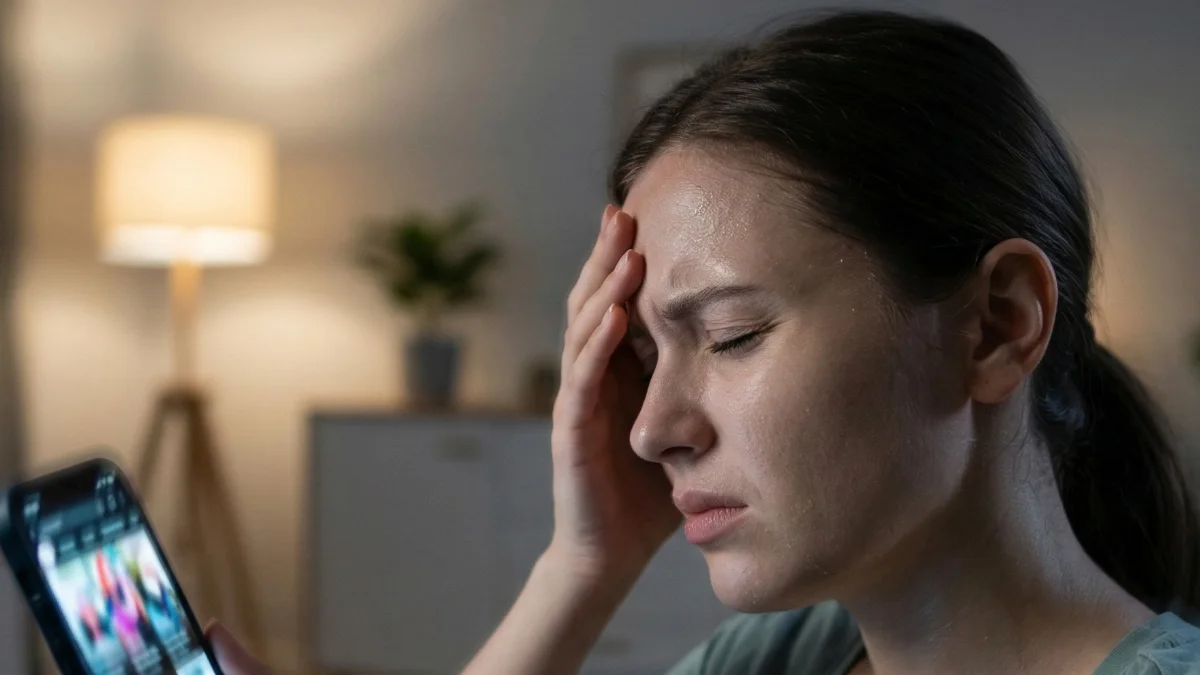
Could Daily Screen Use Be Making You 'Screen Sick'?
It's more than fatigue. Screen sickness can throw off your balance and trigger deep evolutionary stress responses.

Have you ever closed your laptop after a long Zoom call and felt a sudden wave of dizziness? Have you laid in bed scrolling through short-form videos, only to look up and feel a strange "lag" in your vision, as if the real world isn't rendering fast enough? Do you experience a low-grade nausea that you can't quite pin on something you ate?
This may not be "tiredness." Instead, it could be symptomatic of a physiological condition known as cybersickness, a digital cousin of motion sickness that is becoming increasingly prevalent as digital lives become more entwined with our rapidly shrinking analog lives.
To help you distinguish between standard fatigue and this specific sensory disconnect, I have developed a new science-inspired tool called the Screen Sick Test. You can take it to uncover whether your technology use is a cause for concern. It's not meant to be diagnostic, but it can serve as a useful starting point for self-reflection and change.
Why does screen sickness happen? To understand it, we have to look at the evolutionary mismatch between our Pleistocene bodies and emerging technology.
The Neuroscience Of Feeling 'Screen Sick'
At its core, cybersickness is explained by sensory conflict theory. Your brain constructs its sense of reality and spatial orientation by triangulating data from three primary sources:
- The visual system, which is what your eyes see.
- The vestibular system, which is what the fluids in your inner ear tell you about gravity and acceleration.
- The proprioceptive system, which is what your muscles and joints tell you about your limb position.
For 99.9% of human history, these three systems were in perfect lockstep. If your eyes saw the world rushing past you, your inner ear felt the acceleration of running and your legs felt the impact of the ground. Modern screens, however — specifically high-definition screens with smooth scrolling and high refresh rates — break this alliance.
When you scroll rapidly through a feed, your eyes process a massive amount of "optical flow." Your visual cortex receives the input that you are moving forward and that you are moving fast. However, your vestibular system in your inner ear sends a conflicting report, saying that you are perfectly still, sitting on the couch.
This mismatch triggers a specific alarm in the brain. In nature, the only time your eyes and ears would fundamentally disagree like this was if you had ingested a neurotoxin, a poisonous berry or mushroom that disrupted your neurological processing. Evolution, in its protective wisdom, devised a simple solution for neurotoxicity: commanding the body to eject the contents of the stomach.
The nausea, the clamminess and the dizziness you feel after too much scrolling are effectively your brain thinking it has been poisoned and trying to save your life. You aren't just "bored" or "tired"; you are experiencing a vestigial panic response.
How Screen Sickness Affects Your Vision
The severity of screen sickness is often dictated by a phenomenon called vection, or the illusion of self-motion. We have all experienced vection in the real world. Think about sitting in a stationary train when the train next to you begins to move. For a split second, your brain is convinced you are the one moving, thanks to the phenomenon of vection.
Designers of modern user interfaces love vection. They use parallax effects (where the background moves slower than the foreground) and smooth scrolling animations to make digital environments feel immersive and fluid. While aesthetically pleasing, these design choices increase the cognitive load on the brain. They make the illusion of motion more convincing, which unfortunately makes the sensory conflict more severe.
Furthermore, as our screens get larger and we hold them closer to our faces, they occupy more of our peripheral vision. Our peripheral vision is highly sensitive to motion cues (probably a survival trait, for spotting predators and the like). When a screen fills your field of view, the anchor of the stationary room around you disappears. Without that stationary anchor, the brain loses its reference point, and the feeling of cybersickness can take hold or intensify.
Going Back From Screen Sickness To Balance
If your test results suggest high levels of screen sickness, it does not mean that you are fragile or weak. It just means that your sensory processing systems are functioning exactly as they were designed to, in an environment they didn't evolve in. Here is how to mitigate the effects without going completely offline:
- Reintroduce the horizon. This effective way to combat sensory conflict gives the vestibular system a "truth anchor." Every 15 to 20 minutes, engage in distinct "horizon gazing" by looking at a fixed point across the room or out a window. This confirms to your brain that you are, in fact, stationary.
- Turn off smooth scrolling. Many smartphones and operating systems allow you to reduce motion. Search your accessibility settings for "reduce motion." This turns off the zooming transitions and parallax effects. It might make your phone feel slightly less premium or fluid, but it significantly reduces the vection cues that trigger nausea.
- The chewing gum hack. It sounds too simple to be true, but chewing gum can help reduce cybersickness. There are a few theories as to why this works, but one prevailing idea is that the rhythmic motor activity of the jaw provides a distraction and generates somatic sensory signals that can override the vestibular mismatch.
- Respect the 20-20-20 Rule. This is the gold standard for a reason. Every 20 minutes, look at something 20 feet away for 20 seconds. This breaks the ciliary muscle spasm and allows the blink reflex to reset.
We are living through a massive, uncontrolled experiment in sensory adaptation. We are asking our biology to process inputs it never evolved to handle. If you feel sick, dizzy or foggy, don't ignore it. It is your brain's way of asking for a reality check.
Listen to the signal, put the screen down and take a pause long enough for the room to stop spinning. Whatever you're busy with on the screen can wait; your vestibular system needs a moment to find its footing again.
Want to know if you're more affected by screen sickness than your peers? Take my science-inspired Screen Sick Test for an instant answer.
About the Author
Mark Travers, Ph.D., is the founder of Therapytips.org, where he helps match new clients with the right therapist on the team — request a session or get matched here. Mark received his B.A. in psychology, magna cum laude, from Cornell University and his M.A. and Ph.D. from the University of Colorado Boulder. His academic research has been published in leading psychology journals and featured in major outlets including The New York Times and The New Yorker. He is a regular contributor for Forbes, CNBC, and Psychology Today.
More Articles For You
-
Psychologist: This Is The Fastest Way Out Of A Negative Thought Spiral
You can never think your way out of a thought trap, the solution lies somewhere else.
-
Psychologist: Only This 1 Habit Can Break Your Validation Addiction
Seeking approval can turn into an addiction. Only one habit can protect you from it.