3 Signs Being Single Is The Healthier Choice For You
Used intentionally, time alone can strengthen self-love and reshape how you approach future relationships.

Most people treat singlehood as a waiting room. It's seen as a temporary, slightly embarrassing state to pass through as quickly as possible on the way to something more legitimate. This cultural script is so ingrained in us that we rarely stop to question it: find someone, couple up, and only then can your life properly begin.
But what if that urgency isn't coming from genuine desire? What if, for many people, the rush toward a relationship is less about love and more about anxiety — about social pressure, the fear of being left behind or an incomplete relationship with themselves?
These are the people who are more likely to "settle" for relationships in an attempt to flee singlehood, and often end up in bonds with poor boundaries.
Psychologist Bella DePaulo's 2023 research from the Journal of Family Theory & Review challenges these assumptions about singlehood. She distinguishes between people who are single by circumstance and those who genuinely flourish alone, arguing that the happiness gap between single and coupled people is far narrower than popular culture suggests, and often disappears entirely when personal choice is factored in.
None of what follows is an argument against relationships. It's an argument for the kind of self-knowledge that makes a relationship worth having. Sometimes, the most psychologically sophisticated thing a person can do is resist a cultural script long enough to ask themselves, "Do I actually want this right now, or have I just been told that I should?"
Here are three signs that being single right now might be the more honest and, ultimately, healthier choice.
1. You're Drawn To Partners (Not Partnerships) When You're Single
There's a particular kind of person who feels most alive at the beginning of something. The texts that arrive a little too fast; the electric uncertainty of whether someone likes you back; the way a new connection can make an ordinary Tuesday feel charged with meaning. It feels like love.
But psychologist Dorothy Tennov, who has spent years studying romantic obsession, has a different name for it: limerence. Limerence is the intense, involuntary pull toward another person that characterizes early-stage romantic pursuit. It's not fraudulent because the feelings are real, but it is neurologically closer to anxiety relief than to genuine intimacy.
Classical brain-imaging research from Psychological Medicine notes that people in the early stages of romantic pursuit show activation patterns strikingly similar to those seen in obsessive-compulsive disorder. The brain isn't falling in love so much as it's fixating, seeking resolution to an open loop.
The sign to pay attention to is what happens after the loop closes: after someone likes you back, the uncertainty settles and things become stable. For people who are genuinely drawn to partnership, that's when a relationship deepens. But for people who are drawn to pursuit, that's often when restlessness begins.
If you find yourself repeatedly energized by new connections and inexplicably flat once they become secure, the honest question isn't, "Why can't I find the right person?" Rather, it's, "What am I actually looking for when I look for someone?" That question is worth considering deeply and, if required, repeatedly, before asking anyone else to be the answer.
2. Your Sense Of Self Is Tied To Your Relationship Status (And Flatlines When You're Single)
Consider how it feels to walk into a social situation where you know people will ask whether you're seeing someone. For some, it's a neutral question. For others, it functions less like small talk and more like a performance review. In other words, some people register an inquiry like that as a moment where some invisible score is updated based on their answer.
This is known as contingent self-esteem: a sense of personal value that's tied to external validation rather than internal stability, which is a fragile foundation for anyone's self-worth. And when relationship status becomes a primary source of that validation, being single doesn't merely feel lonely; it feels like evidence of something wrong.
The problem isn't necessarily with wanting a relationship. The problem is when the desire for a relationship becomes inseparable from the need to feel acceptable.
Research on relationship-contingent self-esteem has consistently found that people who rely on romantic partnerships for their sense of worth are more likely to suppress their own needs within relationships and more likely to stay in unsatisfying ones. They're also ultimately less satisfied, even when things appear to be going well.
The hard pill to swallow in this story is that the work of building a more stable self-concept that doesn't depend on being chosen can only be done while single. Every relationship entered from a place of "I need this to feel okay" delays that work because it fails to replace it.
If you notice that your baseline sense of yourself shifts meaningfully depending on whether you're with someone, that's not a reason to find someone faster. It's a sign that the more valuable project is waiting for your undivided attention.
3. You Have A Pattern You Haven't Been Single Long Enough To Examine
Most people who've been through a few relationships have, at some point, noticed a theme. Not always the dramatic kind, like, "I always date someone cruel" or "It always ends the same way." Often, it's more:
- Feeling as though your partners never truly see you
- Being the one who cares a little more
- Feeling like the unspoken manager for the emotional temperature of your relationships
- Feeling compelled to shrink yourself to make your partners more comfortable
Attachment theory offers one explanation for why these patterns persist. The relational dynamics we experienced earliest become deeply grooved defaults that shape who we're drawn to, how we behave when we feel threatened and what "normal" feels like inside a relationship. Familiarity, even painful familiarity, can register with the nervous system as safety.
The difficulty is that these patterns are almost impossible to examine clearly from inside a relationship. There's too much happening: too much to manage, too much to feel, too many opportunities to locate the problem in the other person rather than in the dynamic you keep recreating together. It's not a failure of intelligence or self-awareness. It's simply how close proximity works. We can't see the shape of something we're standing inside.
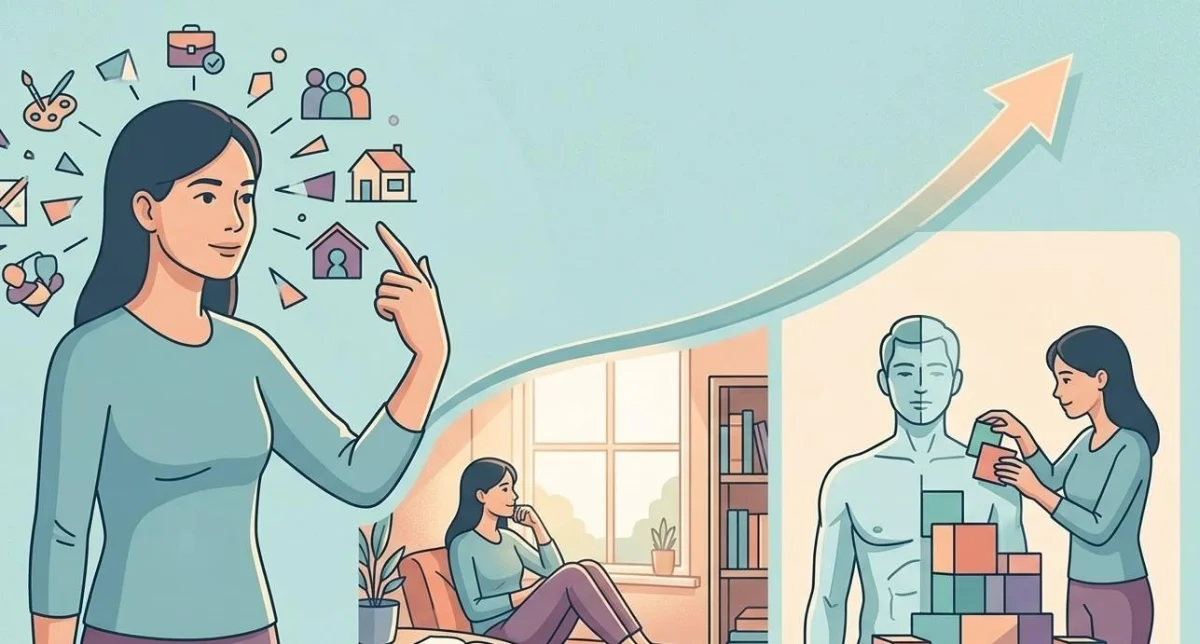
Research shows that self-concept clarity often declines right after a romantic breakup, but it tends to recover as individuals spend time reflecting on themselves and re-constructing their self-identity, rather than immediately entering another relationship. Higher self-concept clarity after such a period of single reflection has been linked with better psychological adjustment post-breakup.
Recognizing a pattern isn't the same as being broken. It doesn't mean your history has condemned you to repeat itself. But you can only examine a pattern from outside of it, and singlehood, for all of its discomforts, offers exactly that vantage point.
None of these signs are a permanent verdict on your worthiness of love. They're not evidence that you're too damaged for a relationship, or that wanting one is naive or that love isn't worth the mess or risk. They're invitations to a different question, one that's harder than "How do I find someone?" but more worth asking: "Who am I when no one is watching, and is that person someone I actually know?"
The research on single living doesn't argue against love. It argues for the conditions that make love sustainable. And sometimes those conditions are built best in solitude, on your own terms, before someone else enters the picture.
Take my science-inspired Relationship Red Lines Test to know if your sense of self and your boundaries stay as intact in a relationship as they are when you're single.
About the Author
Mark Travers, Ph.D., is the founder of Therapytips.org, where he helps match new clients with the right therapist on the team — request a session or get matched here. Mark received his B.A. in psychology, magna cum laude, from Cornell University and his M.A. and Ph.D. from the University of Colorado Boulder. His academic research has been published in leading psychology journals and featured in major outlets including The New York Times and The New Yorker. He is a regular contributor for Forbes, CNBC, and Psychology Today.
More Articles For You
-
Post-Traumatic Stress and how to cure it in one session.
What is the Rewind Technique?
-
Psychologist: A Sneaky Habit That Cuts You Off From Your Gut Instinct
Ignoring your instincts will dull them, but this habit will kill them.