
Psychologist: The No. 1 Mental Habit of People Who Love Their Jobs
After years studying how people relate to their work, I've noticed the deepest career satisfaction never comes from where most people look for it.

As a psychologist who studies performance and decision making, I have spent years looking at the question of what actually separates people who love their work from people who dread it. The findings are counterintuitive. The people who love their jobs and the people who dread them are rarely separated by what they do. They are separated by how they relate to what they do.
The dominant advice tells you to find the right fit, follow your passion, align your values. This advice is not wrong, exactly. But it misunderstands the timeline.
The Habit Itself: Treating The Job As A Journey, Not A Destination
The pattern that shows up most consistently in the research is this: people who love their work are oriented toward the journey of their career, not the verdict of any single moment in it.
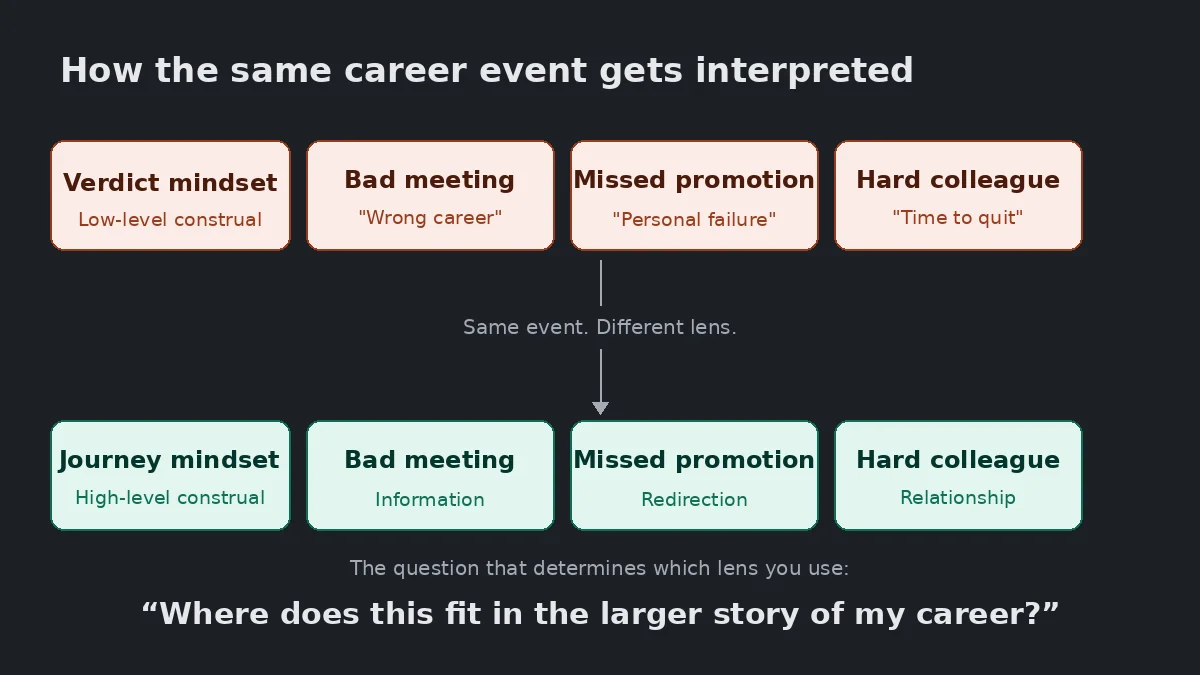
When something difficult happens at work — a bad meeting, a missed promotion, a frustrating colleague, a stretch of months where the work feels meaningless — they do not interpret it as evidence that they are in the wrong career. They interpret it as part of a longer story they are still writing. The bad meeting is information. The missed promotion is a redirection. The frustrating colleague is a relationship to navigate. The meaningless stretch is a phase of a career that has had other phases and will have more.
People who dread their jobs do the opposite. They treat every difficult moment as a referendum. Every bad day becomes evidence that they should have chosen differently. Every conflict becomes proof of mismatch. Every period of boredom becomes a sign that the work is not for them. Their career exists at the resolution of whatever they are feeling right now.
There is a useful framework for understanding this difference. Social psychologists call it construal level theory. When you construe an event at a low level — close up, in the immediate moment, dominated by sensory and emotional detail — it feels urgent and definitive. When you construe the same event at a high level — zoomed out, contextual, placed inside a larger arc — it feels like a data point in a longer pattern. People who report high career satisfaction have, often without realizing it, trained themselves to construe career events at a high level by default.
Why This Matters More Than "Fit"
Studies of job changers reveal something important about the search for the right fit. People who have changed jobs five times in ten years looking for the right one rarely find what they are searching for. Not because they are searching wrong, but because no job is internally consistent enough to be a stable source of satisfaction. Every job has bad weeks. Every team has friction. Every meaningful pursuit has phases that feel pointless from the inside.
The people who appear to have found the right fit usually have not. They have found a relationship to their work in which difficult moments do not register as identity-level threats. They are not chasing the perfect job. They are tolerating the imperfect one, moving forward in their development, with the long view in mind.
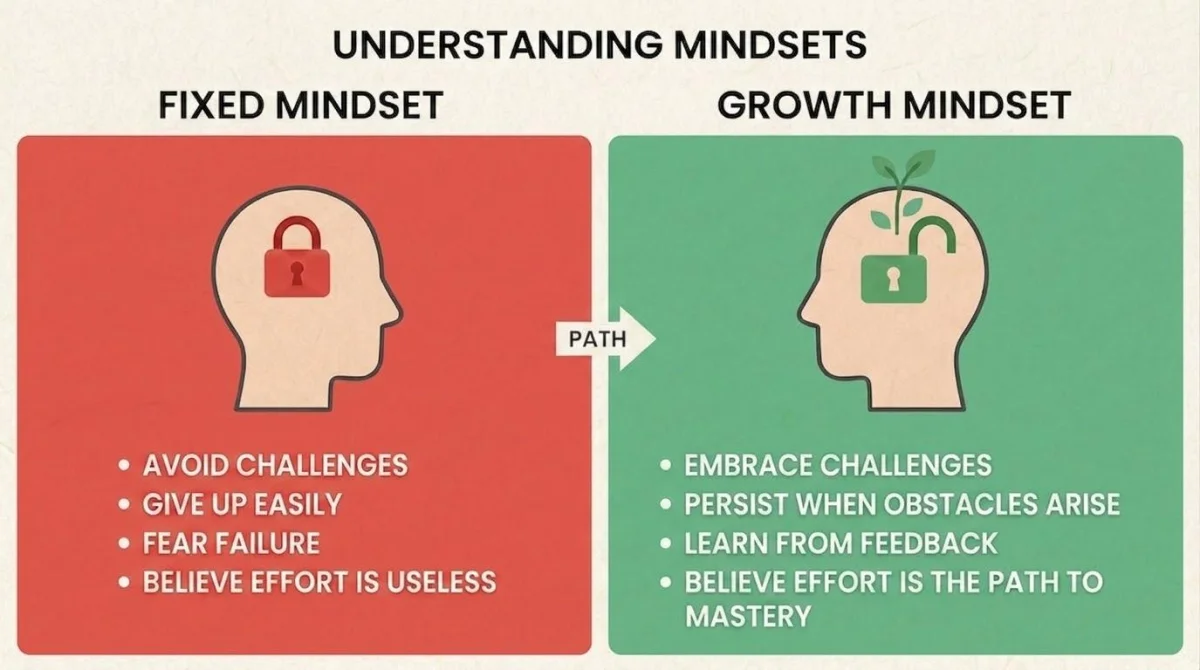
This is also what growth mindset, properly understood, actually means. Carol Dweck's research was not about positive thinking or telling yourself you can do anything. It was about whether you treat your current ability as a fixed verdict or as a current position in a longer trajectory of development. Applied to careers, growth mindset is the same insight. Your current job satisfaction is not a verdict on whether this work is for you. It is a current position. The question is whether you are oriented toward what comes next.
The Concrete Version: Where Journey Mindset Gets Tested
If high-level construal feels too abstract, apply it to the most tangible part of any working day: the people you work with.
Research on job satisfaction consistently surfaces one finding that surprises people. The hours you actually spend at work — meetings, Slack threads, hallway conversations, feedback discussions, negotiations with peers — are mostly interpersonal. The texture of a working life is shaped less by the work itself than by who you do it with. This is why people who like their colleagues report higher satisfaction even when the work is not what they imagined doing as a child.
But here is where the journey mindset matters most. People with a verdict mindset treat every difficult colleague as proof they are in the wrong job. People with a journey mindset treat the same colleague as a relationship to navigate. The interpersonal challenges of work are not separate from the question of whether you love your job. They are the daily test of how you have learned to construe the difficulties that come with any meaningful work.
You will encounter a frustrating coworker no matter where you work. The question is not whether your next job has nicer people. It is whether you respond to that frustrating coworker as a referendum on the job or as a puzzle to figure out. The answer to that question, over enough years, is most of the difference between people who love their work and people who don’t.
What This Looks Like In Practice
Construal level is not something most people change overnight. But it does shift incrementally when people consistently do one thing: when something difficult happens at work, asking themselves "where does this fit in the larger story of my career?" before they ask "what does this say about whether this job is right for me?"
The first question opens up time. The second question collapses it into a verdict.
If you want to understand more about how you tend to relate to challenge, change, and growth at work, take my Growth Mindset Scale — it reveals whether you lean toward seeing your career as a fixed verdict or an unfolding story.
About the Author
Mark Travers, Ph.D., is the founder of Therapytips.org, where he helps match new clients with the right therapist on the team — request a session or get matched here. Mark received his B.A. in psychology, magna cum laude, from Cornell University and his M.A. and Ph.D. from the University of Colorado Boulder. His academic research has been published in leading psychology journals and featured in major outlets including The New York Times and The New Yorker. He is a regular contributor for Forbes, CNBC, and Psychology Today.
More Articles For You
-
Post-Traumatic Stress and how to cure it in one session.
What is the Rewind Technique?
-
Psychologist: Only This 1 Habit Can Break Your Validation Addiction
Seeking approval can turn into an addiction. Only one habit can protect you from it.