
4 Signs You Have an Anxious Attachment Style — Explained By A Psychologist
How a deep-seated fear of abandonment can quietly sabotage your adult relationships.

Attachment theory, originally developed by psychologist John Bowlby, suggests that the bond we form with our primary caregivers in infancy creates a powerful "internal working model" for all our future relationships.
While those with a "secure" attachment style feel comfortable with intimacy and independence, roughly 20% the population develops an "anxious-preoccupied" attachment style. If you fell into this category, your earliest bonds may have been inconsistent or intrusive, leaving you with a nervous system that is highly tuned to the threat of rejection.
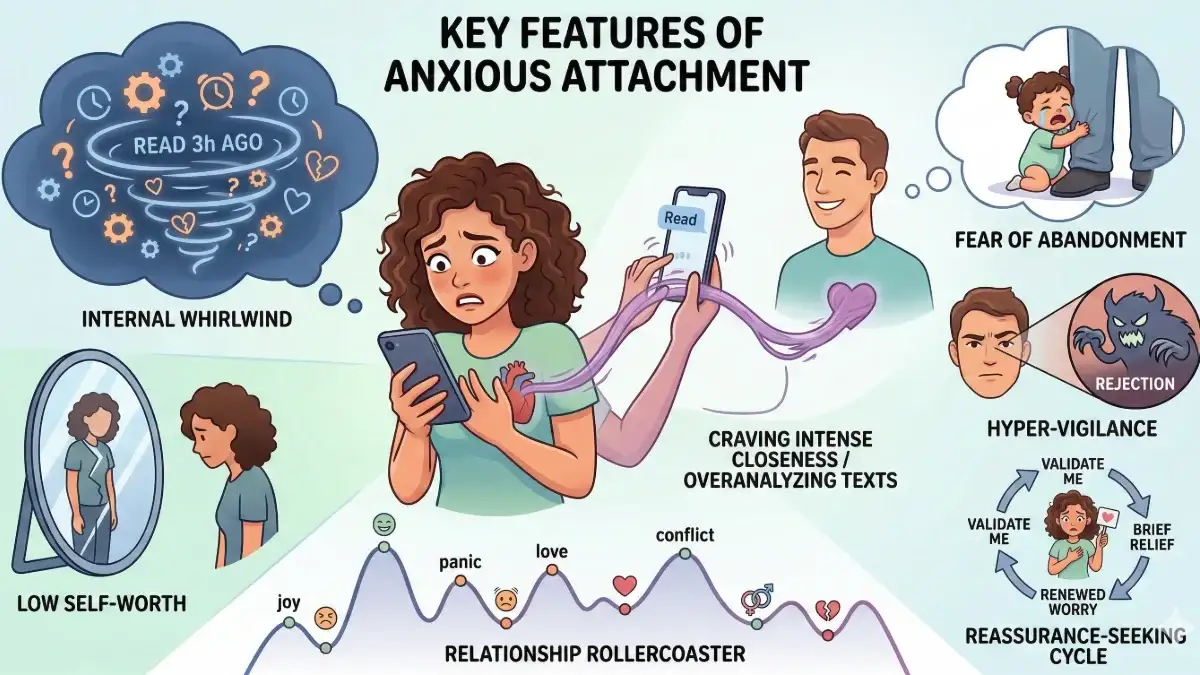
In adulthood, this manifests not as a character flaw, but as a rigid strategy to maintain closeness at all costs. Here are four research-backed signs that you may be navigating your romantic life through the lens of anxious attachment.
1. You Crave Constant Reassurance
Because your internal model doesn't trust that love is stable, you require frequent external validation to feel secure. You might find yourself needing to hear "I love you" multiple times a day or feeling an intense surge of panic if your partner seems slightly distant or distracted. This isn't "needing too much"; it is your system checking for a "pulse" on the relationship.
2. You Are a Master of "Mind Reading"
Anxious attachment styles possess an almost supernatural ability to detect shifts in their partner's mood, tone, or body language. However, this skill is a double-edged sword. Research shows that while they are highly accurate at detecting changes, they often misinterpret non-threatening changes (like a partner being tired from work) as direct "rejection events."
3. You Often Abandon Your Own Needs to Please Them
To avoid conflict—which you interpret as a prelude to abandonment—you often adopt a "chameleon" strategy. You may find yourself agreeing to plans you hate, adopting your partner’s hobbies, or suppressing your own valid frustrations just to keep the emotional peace. The psychological reasoning is: "If I am perfect and undemanding, they won't have a reason to leave."
4. Conflict Feels Like an Existential Threat

For a securely attached person, a fight is a problem to be solved. For an anxiously attached person, a fight feels like the end of the world. Because you lack "emotional object permanence"—the ability to trust the love exists even when it isn't being actively demonstrated—any disagreement triggers an overwhelming panic response.
If you recognize these signs, you aren't broken. The goal isn't to eliminate your anxious tendences, but to "earn security" through conscious effort. This involves:
- Learning your triggers: Recognizing the exact moments your panic is activated.
- Slowing down the response: Pausing before sending that 10th text message.
- Communicating needs clearly: Saying "I'm feeling a little anxious, could I get a hug?" instead of acting out.
Your attachment style is the story of your past, but it does not have to be the script for your future relationships.
Curious to know if you're able to "hold the line" in a relationship? Take our science-inspired Relationship Red Lines Test for an instant answer.
About the Author
Mark Travers, Ph.D., is the founder of Therapytips.org, where he helps match new clients with the right therapist on the team — request a session or get matched here. Mark received his B.A. in psychology, magna cum laude, from Cornell University and his M.A. and Ph.D. from the University of Colorado Boulder. His academic research has been published in leading psychology journals and featured in major outlets including The New York Times and The New Yorker. He is a regular contributor for Forbes, CNBC, and Psychology Today.
More Articles For You
-
Psychologist: This Is The Rarest Type Of Intelligence
Here’s why integrative intelligence is so hard to come by, and usually doesn’t register on intelligence tests.
-
Psychologist: This Is The Fastest Way Out Of A Negative Thought Spiral
You can never think your way out of a thought trap, the solution lies somewhere else.