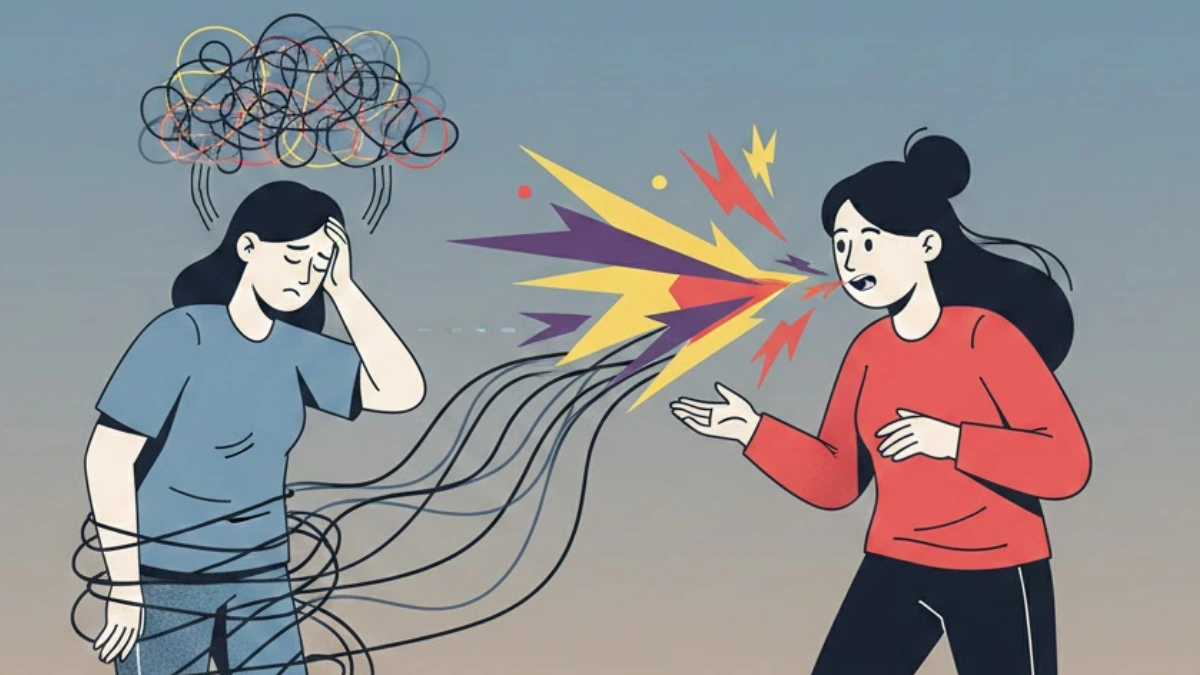
3 Ways You Are Making Yourself Smaller
Many learned to shrink to belong. These patterns can be unlearned so you can expand, set boundaries, and live fully on your own terms.

Most of the social behaviors that we pick up as children to survive become the very limitations that restrict us as adults. We are taught to be agreeable and adapt to our surroundings even before we are taught how to take up space. And for most individuals, this method of "shrinking" does not feel like self-suppression. Instead, we're conditioned to internalize it as politeness or rationality.
However, these little self-editing gestures accumulate over time. For instance, we might start talk less openly, unknowingly cut down our needs or even begin to soften our views. We make ourselves more digestible, manageable and overlookable when we're living by rules that no longer apply to us or our environment.
(Take my science-inspired Inner Voice Archetype Test to know if your inner voice tells you to shirnk or expand.)
This kind of shrinking is rarely a conscious choice. More often, it's a learned strategy shaped by early life reinforcement, attachment patterns as well as social norms.
Here are three of the most common ways people unconsciously learn to shrink themselves, often without ever naming it as such.
1. Shrinking By Self-Silencing So We Can Belong
One of the earliest lessons we are taught is that social harmony depends on emotional regulation, specifically, regulating down. Children quickly learn which emotions are welcomed and which ones create discomfort in others. Joy is encouraged, and curiosity is often rewarded. But anger, sadness, intensity or disagreement tend to be met with withdrawal, tension, correction or punishment.
This emotional regulation does not take place in isolation. Studies of emotion socialization find that parents' own emotion regulation styles, along with how they respond to their children's feelings, directly shape how children learn to manage and express emotion.
When caregivers consistently coach and support emotional expression, children develop more adaptive regulation. When emotions are dismissed, minimized or treated as disruptive, children learn to inhibit or edit their internal states in order to preserve connection. In this way, emotional expression becomes negotiated around belonging.
This is one of the major reasons for conditional self-acceptance, which is the belief that one is lovable only if they are easier to soothe and manage.
Additionally, in environments where caregivers are emotionally inconsistent or overwhelmed, children often become skilled at reading the room, anticipating reactions and preemptively adjusting their behavior. This is adaptive and feels rewarding as it stabilizes relationships. But it also trains the nervous system to associate authenticity with risk.
In adulthood, this shows up as chronic self-silencing:
- Hesitating before expressing disagreement
- Minimizing one's own distress
- Saying "it's fine" when it isn't
- Defaulting to emotional neutrality, even in intimate relationships
It's important ot note here that self-silencing can become reflexive over time, because it becomes the body's learned response to the threat of relational rupture.
People who self-silence often experience emotional incongruence, a persistent gap between internal experience and external expression. Maintaining that gap is physiologically and psychologically costly, and it is associated with higher levels of anxiety, depression and somatic symptoms because the system is constantly managing unexpressed affect.
Shrinking, in this case, is not about lacking confidence. It is about having learned, very early on, that visibility costs too much.
2. Shrinking By Becoming Too 'Adaptable'
Adaptability is one of the most socially praised traits. We celebrate flexibility, openness and the ability to "go with the flow." But, psychologically, adaptability has a shadow side. When taken too far, it can blur the boundary between adjusting to others and abandoning oneself.
This dynamic is closely related to one's self-concept clarity. Longitudinal research shows that adolescents with clearer self-concepts consistently report higher emotional well-being and life satisfaction, and that identity clarity and well-being appear to reinforce one another over time.
People with low self-concept clarity often describe themselves in relational terms: who they are with different people, in different contexts, in different roles. On the surface, this might look like versatility. But, in reality, it feels like diffusion. These are the people who:
- Mirror others' preferences without noticing
- Struggle to answer simple questions like, "What do you want?"
- Feel strangely empty when alone
- Change opinions depending on the audience
In many cases, this pattern develops in families or cultures where individuality is actively or subtly discouraged. When belonging is contingent on alignment, differentiation feels dangerous. The nervous system learns that being distinct threatens connection.
So, the self becomes relationally outsourced. Instead of asking, "What do I feel?" the question becomes, "What is expected of me here?" Instead of, "What matters to me?" it becomes, "What will keep the peace?"
The concern here is that shrinking does not feel like suppression. It feels like being "low-maintenance." But the long-term cost is a fragile identity, one that exists mostly in relation to others and collapses in their absence. And because self-concept clarity and well-being feed into each other, that fragility is not emotionally neutral. It undermines stability, satisfaction and the ability to feel anchored in one's own life.
3. Shrinking By Treating Our Needs As A Burden
Perhaps the most pervasive way people shrink is through how they relate to their own needs. Self-Determination Theory posits that autonomy, competence and relatedness are innate psychological needs that sustain motivation and mental health. Environments that support these needs promote engagement and well-being, whereas environments that thwart them foster passivity and alienation.
Despite this, many individuals are raised in contexts where needs are tolerated only when they are minimal and easily managed. This can lead to need aversion, or a learned discomfort with having needs at all.
This shows up as:
- Apologizing for asking for help
- Downplaying exhaustion, stress or dissatisfaction
- Feeling guilty for wanting more
- Preferring to be the helper rather than the one who needs help
Increases in such behaviour can further contribute to over-functioning in a way that renders the person indispensable but invisible to themselves. Many people report feeling strangely lonely despite being constantly needed. They are present in everyone's life, but not fully present in their own.
Shrinking here is a reflection of internalized unworthiness: the belief that one's needs are excessive, inconvenient or morally suspect. Over time, this belief becomes so normalized that people cannot distinguish between genuine selflessness and chronic self-erasure.
Across all three patterns, the core mechanism is the same: shrinking is a safety behavior. It is the nervous system doing what it learned to do: minimize threat, preserve connection and reduce overall friction.
This makes perfect sense, but only evolutionary. Modern environments require a different set of skills: self-definition, emotional expression, boundary-setting and psychological visibility. The nervous system, however, does not update automatically. It continues to operate on outdated threat models. It treats disagreement as danger. Needs as liability. Authenticity as risk.
So, people shrink not because they want less from life, but because their system is optimized for not losing what they already have.
How To Stop Shrinking And Start Taking Up Space
The opposite of shrinking is not grandiosity or dominance. It is psychological expansion, and the ability to occupy one's internal and external life without excessive self-editing.
This involves:
- Tolerating mild interpersonal discomfort
- Allowing emotions to be seen
- Letting preferences exist without justification
- Risking being misunderstood
- Practicing being a subject, not just an object in others' narratives
To begin, repeatedly practice interoception by learning to notice internal signals before external cues through questions like, "What do I feel? What do I want? What am I avoiding?" These questions sound simple, but for people who have spent years shrinking, they can feel strangely radical.
Taking up space is not about becoming louder. It's more about becoming truer, less optimized for approval and less constrained by anticipation.
Take the Growth Mindset Scale to see how much room you have to grow and show up more fully in your relationship.
Then try my science-inspired Boundary Setting Style Quiz to discover how you draw (or blur) your lines and how that affects you proclivity for shrinking.
About the Author
Mark Travers, Ph.D., is the lead psychologist at Awake Therapy, responsible for new client intake and placement. Mark received his B.A. in psychology, magna cum laude, from Cornell University and his M.A. and Ph.D. from the University of Colorado Boulder. His academic research has been published in leading psychology journals and has been featured in The New York Times and The New Yorker. He is a regular contributor for Forbes, CNBC, and Psychology Today. Click here to schedule an initial consultation with Mark or another member of the Awake Therapy team.
More Articles For You
-
3 Psychological Reasons Why You Miss People Who Hurt You
Understanding the science behind emotional attachment can help you stop romanticizing what caused pain.
-
5 Signs You're Emotionally Draining The People Around You
Emotional fatigue isn't always intentional. Here's how certain habits can overwhelm others without you realizing it.