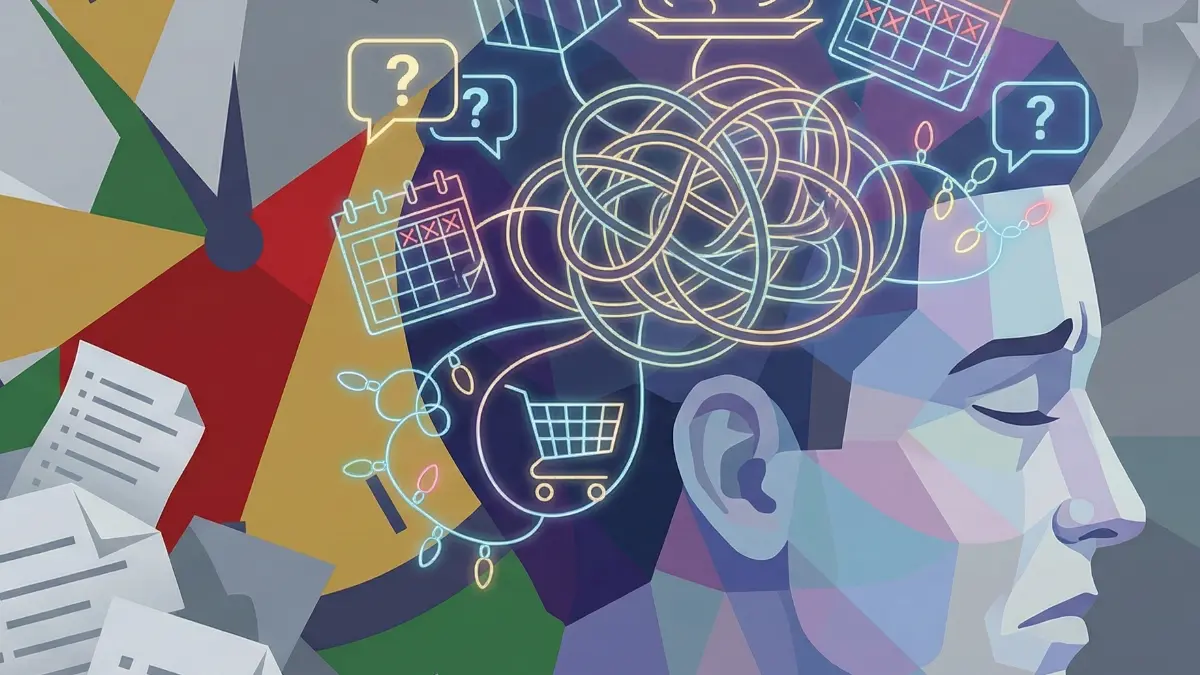
2 Mental Health 'Taxes' Of The Holiday Season
From emotional overload to unrealistic expectations, these hidden costs often come before celebration.

For many people, Christmas and Thanksgiving don't begin with warmth or connection. They instead begin with never-ending lists of groceries, guests and gifts. And these lists aren't just physical; they're mental ones that remain open and alive permanently in the back of our minds. And these elaborate plans of enjoyment exact a heavy "holiday tax" on the psyche of the ones in charge, especially if they're doing it alone.
On paper, holiday planning should be manageable: you just have to make a few extra decisions spread over a few weeks. As the holidays inch closer, however, those decisions become heavier, more demanding and complicated. And when the moment of celebration finally arrives, many people feel depleted, irritable and oddly disconnected from the very merriment they worked so hard to create. These misplaced feelings aren't a result of a lack of organization or some kind of failure, but due to an unprecedented influx of stressors.
Psychological research shows that holiday planning activates multiple hidden mental stressors simultaneously, ones that quietly tax working memory, drain self-control and turn anticipation into labor. Here are two hidden psychological reasons why Christmas and Thanksgiving planning is so stressful, even when it's meaningful.
1. The Holiday Tax Of Cognitive Load
The first hidden stressor is the cognitive load, or the amount of information your brain must hold and manipulate at once. Our working memories, that help us navigate and manipulate "active" tasks and decisions, can only juggle a small number of variables before performance drops and stress rises. Christmas and Thanksgiving planning push that limit fast.
Planning for guests, getting headcounts and RSVPs, accounting for preferences and dietary considerations, matching specific gifts with specific gifts and all the effort required to implement these plans can push anyone to the brink.
Unlike a single task that goes from conception to completion, holiday planning is a persistent mental background process that keeps running in the background, even when you're not actively planning. This means that "unfinished loops" remain open in your working memory.
And this ongoing cognitive and emotional responsibility of organizing tasks, remembering details, and anticipating needs is the notorious "invisible work" many people, most of them women, carry in household and family contexts.
A 2024 study published in Archives of Women's Mental Health found that increased cognitive household labor, like the thinking and planning tasks hidden behind holiday preparation, was associated with higher stress, burnout and poorer mental health outcomes. This more commonly affects women, who are primarily tasked with most of the planning burden.
When unfinished planning tasks and anticipations remain unresolved, they're held in your working memory. And since your working memory's primary function is to facilitate processing, and not to record long-term information, every unresolved detail quietly occupies cognitive capacity until it's acted on.
And that makes holiday planning a poorly-bounded, emotionally charged and frequently interrupted responsibility for the one carrying it. Each unfinished decision continues to occupy mental space.
In simpler terms, holiday stress doesn't disappear when you "sit down to relax" because your brain is still holding and constantly reviewing the list.
2. The Holiday Tax Of Decision Fatigue
Holiday planning can look like a few big decisions from afar, but the more you zoom in, the more micro-decisions they splinter into. This includes making decisions about the minutiae of when the guests should arrive, which desserts to make, how much to budget out for gifts, who will sit where and so on. When spread across multiple days and multiple people, these decisions accumulate into a mammoth project.
Research has shown us that repeated acts of decision-making reduce subsequent self-regulation capacity. After many decisions, people become more impulsive, avoidant or emotionally reactive.
Holiday planning has the exact conditions that lead to decision fatigue. The choices we make during this time are frequent, emotionally loaded and socially consequential. For instance, saying "yes" to one invitation means saying no to another. Similarly, one family's tradition conflicts with another's expectations.
Importantly, decision fatigue isn't as transparent as exhaustion, and it often shows up in our behavior as irritability, procrastination and an "I don't care anymore" attitude.
Unresolved choices, therefore, aren't neutral. They keep drawing cognitive energy long after you've thought about them. And information you're mentally rehearsing continues to occupy working memory, even if you're not actively thinking about it.
Later, people often feel guilty about snapping at family, or overspending or abandoning their plans, often without realizing their self-control resources were already depleted.
Why The 'Holiday Tax' Feels So Personal
Christmas and Thanksgiving aren't just events on a calendar; they're symbolic tests of care, competence and belonging. So when you plan them, you're not simply coordinating logistics; you're also managing expectations, preserving long-held traditions and trying to recreate a time of love and happiness for multiple people.
That emotional weight makes the stress especially insidious. Because these holidays are culturally framed as meaningful and joyful, feeling overwhelmed can register as personal failure rather than a predictable cognitive response. People minimize their strain and dismiss the stress, trying to replace them with artificial joy.
That's why holiday stress often feels more personal than work stress. When things go wrong, it doesn't feel like a task failed. It feels like you did. And that's far heavier to carry.
So, the goal isn't to make holidays effortless. Instead, it's to stop your brain from carrying work it was never designed to hold alone. Research on cognitive load, decision fatigue and emotional labor suggests a few effective shifts:
- Stop using your brain as storage. Working memory is for thinking, not remembering. Writing everything down from menus, to guest details, to gift ideas, to timelines and contingencies can help close open loops in your brain, freeing up cognitive space in your brain.Use a shared digital doc with partners and family so that planning is collaborative and visible, not siloed in your head. The rule of thumb is that if you're afraid you'll forget it, it doesn't belong in your head.
- Replace repeated decisions with defaults. Decision fatigue comes from re-deciding the same things every year. Turning them into default fixtures, like the same christmas menu, similar budgets, standard arrival departure times and fixed hosting rules, can protect mental energy. You can always break them intentionally, but they save you from constant deliberation.
- Close decisions earlier than feels necessary. Unmade decisions are heavier than confirmed ones. Psychologically, an unresolved choice continues to consume mental resources, even when you're not actively thinking about it. Even imperfect closure reduces cognitive load more than endless optimization.
- Share and delegate the invisible work. Mental load is often invisible, and invisible work is unevenly distributed. Delegate planning tasks explicitly ("You handle the movie night playlist, and I'll handle decorations."), rotate responsibilities each year and share decision steps so the mental "storage" isn't just yours.
Holiday planning doesn't fail because people aren't organized enough. It fails because it asks the brain to do too much, for too long, without rest. And the real tragedy of holiday stress isn't the mess or the missed detail. It's arriving at the table mentally exhausted, just when presence matters most.
The holiday tax of decision fatigue leads to procrastination. Take the General Procrastination Scale to know if this season is turning out to be expensive for your wellbeing.
Do you give in and pay the holiday tax every year or do you learn and recalibrate your approach as a leader? Take the Historical Figure Quiz to know where your personality leans.
About the Author
Mark Travers, Ph.D., is the founder of Therapytips.org, where he helps match new clients with the right therapist on the team — request a session or get matched here. Mark received his B.A. in psychology, magna cum laude, from Cornell University and his M.A. and Ph.D. from the University of Colorado Boulder. His academic research has been published in leading psychology journals and featured in major outlets including The New York Times and The New Yorker. He is a regular contributor for Forbes, CNBC, and Psychology Today.
More Articles For You
-
Psychologist: A Sneaky Habit That Cuts You Off From Your Gut Instinct
Ignoring your instincts will dull them, but this habit will kill them.
-
Psychologist: This Habit Is The Biggest Motivation Killer For Adults
Seeking external validation is costing you more than you know, and the first thing to go is your sense of autonomy.